
You get one shot a year. Make every decision count.
State fairs, music festivals, food and wine events, and seasonal celebrations build an entire operation from scratch, run it for days or weeks, and then tear it down. Every pricing, staffing, vendor, and layout decision carries twelve months of consequence. accesso Intelligence is the institutional memory that makes each year smarter than the last.

You plan for a year, operate for a week, and learn from a spreadsheet that is already out of date.
Fairs and festivals are built on compressed timelines and high-stakes decisions. You commit to vendor contracts, staffing levels, entertainment lineups, and site layouts months in advance based on last year's numbers and a hope that the weather cooperates. Once gates open, there is no time to analyze. Once gates close, the team scatters and the lessons live in people's heads until next year's planning cycle starts.
Compressed decision windows
The gap between "we need to decide" and "gates open" gets shorter every year, but the decisions do not get simpler. Vendor contracts, staffing, and entertainment lock in months out.
Weather makes or breaks the run
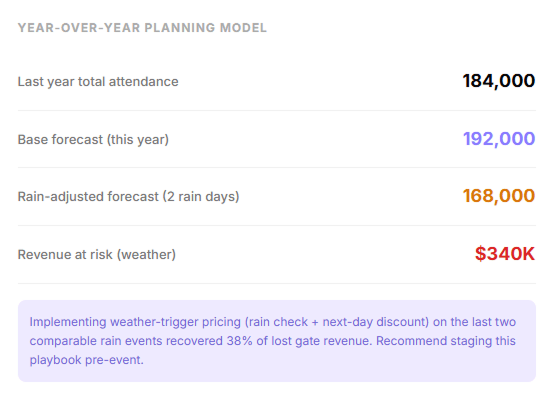
A single rain day during a 10-day fair can represent 10% of total revenue gone. But the response to a weather change takes hours you do not have during operations.
Institutional knowledge walks away
Seasonal staff, rotating volunteers, and vendor turnover mean the people who learned what worked this year may not be the ones making decisions next year.
Vendor and midway revenue opacity
You know gate revenue. But the per-guest spend across food vendors, carnival rides, exhibits, and merchandise is fragmented across dozens of independent operators.
Ask your fair anything. Get answers that remember what you have learned.
accesso Intelligence connects to your ticketing, POS, vendor reporting, weather data, and historical records. It becomes the institutional memory that persists between events, carrying forward every lesson so the next planning cycle starts with intelligence instead of guesswork.
During the run, Intelligence operates in real-time: gate counts, vendor sales, weather shifts, and crowd flow. Between events, it shifts to planning mode: historical analysis, scenario modeling, and vendor performance benchmarking. The AI adapts to wherever you are in the cycle.
Intelligence that adapts to your event cycle
Different questions at different times. Intelligence meets you where you are in the planning, operating, and learning cycle.
Pre-Event Planning Intelligence
Start each planning cycle with the full weight of every prior event behind you. Intelligence synthesizes historical attendance, vendor performance, layout effectiveness, weather patterns, and financial outcomes into actionable planning recommendations. No more starting from scratch.
"What should we change about the site layout based on last year's traffic data?"
"Model three attendance scenarios for this year with different weather assumptions"
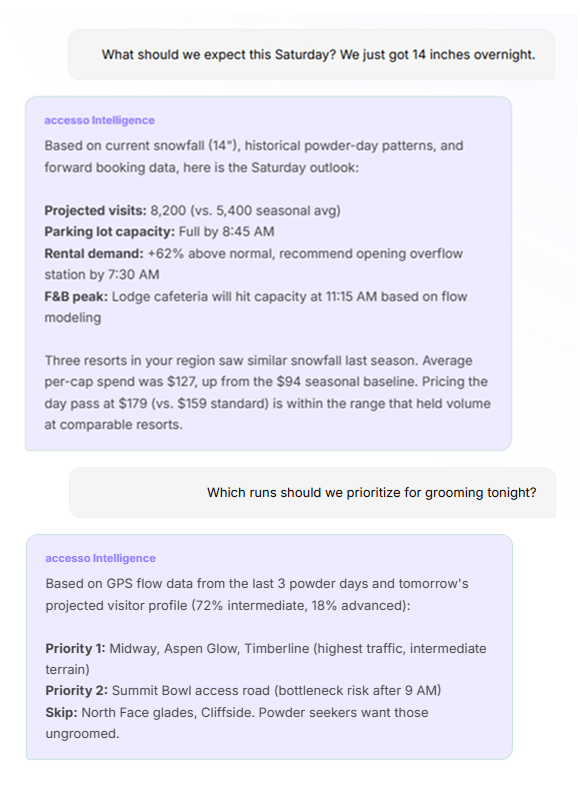
Real-Time Operations During the Run
Once gates open, Intelligence shifts to real-time mode. It monitors hourly attendance against forecast, tracks vendor sales, watches weather changes, and flags operational issues as they develop. Decisions that used to take a post-event review to identify can now be made mid-event.
We are at 12,000 through the gate by 1 PM. How does the rest of the day look?
Which food zones are hitting capacity? Where should we direct overflow?
Vendor and Midway Performance
Track vendor revenue, foot traffic by zone, ride throughput, and per-guest spend across the entire midway and food court. Intelligence benchmarks vendor performance against their location, weather, and day-of-week to separate operator quality from site advantage.
Rank food vendors by revenue per square foot, adjusted for location traffic
Which midway rides had the highest and lowest utilization this year?
Post-Event Analysis and Carry-Forward
The most valuable window for a fair or festival is the one right after the event ends, when the data is fresh and the team still remembers what happened. Intelligence generates comprehensive post-event reports, surfaces the insights that matter most for next year, and stores them so they are ready when planning starts again.
What are the top 5 things we should change for next year?
Generate the post-event report with YoY comparison
Intelligence that adapts to where you are in the year
Unlike year-round operations, fairs and festivals have distinct phases with distinct questions. Intelligence shifts its focus to match.
Every team gets an AI partner that remembers what worked
Not a generic dashboard. An AI that carries forward every lesson from every prior event and adapts its focus to wherever you are in the planning cycle.

Finance
Season revenue projections, per-cap modeling, and budget variance analysis grounded in daily operational data’s.
Finance
Executive Leadership
Hourly staffing models, lift queue predictions, rental demand curves, and grooming prioritization tied to tomorrow's forecast.
Executive Leadership
Marketing
Channel attribution, campaign timing, and pricing promotions based on what actually moves midweek and shoulder-season visits.
Marketing
Operations
Board-ready season summaries, competitive benchmarking, and scenario planning that pulls from every data source in the resort.
Operations
Guest Experience
Unified sentiment from Google, TripAdvisor, surveys, and NPS. Know what guests loved and where they got frustrated, by touchpoint.
Guest Experience
F&B and Retail
Predict lodge cafeteria volume, optimize menu mix by weather and crowd type, and catch inventory gaps before the weekend rush.
F&B and Retail
.png)
A data rich environment – which helps craft and drive what the visitor experience is going to be – means we’re more effective in enabling our visitors to enjoy their time in the museum.

In this uncertain environment, we are using Ask for insights into future admissions trends to project financial impacts and offer actionable strategies. Drawing on historical sales data and patterns in visitor reviews, it delivered a clear projection and actionable strategies to protect revenue and preserve the guest experience.
.png)
This is a real game changer for this industry. You honestly take data for granted when you work in other spaces… we’d spend so much time trying to manually sort this out – to be able to get the efficiencies from a data platform.
Connects to the systems your resort already runs
Pre-built connectors for the platforms ski resorts depend on. Most integrations go live in days, not months.

What would you ask your mountain if it could answer back?
Join the resorts building smarter operations with AI that understands ski.